
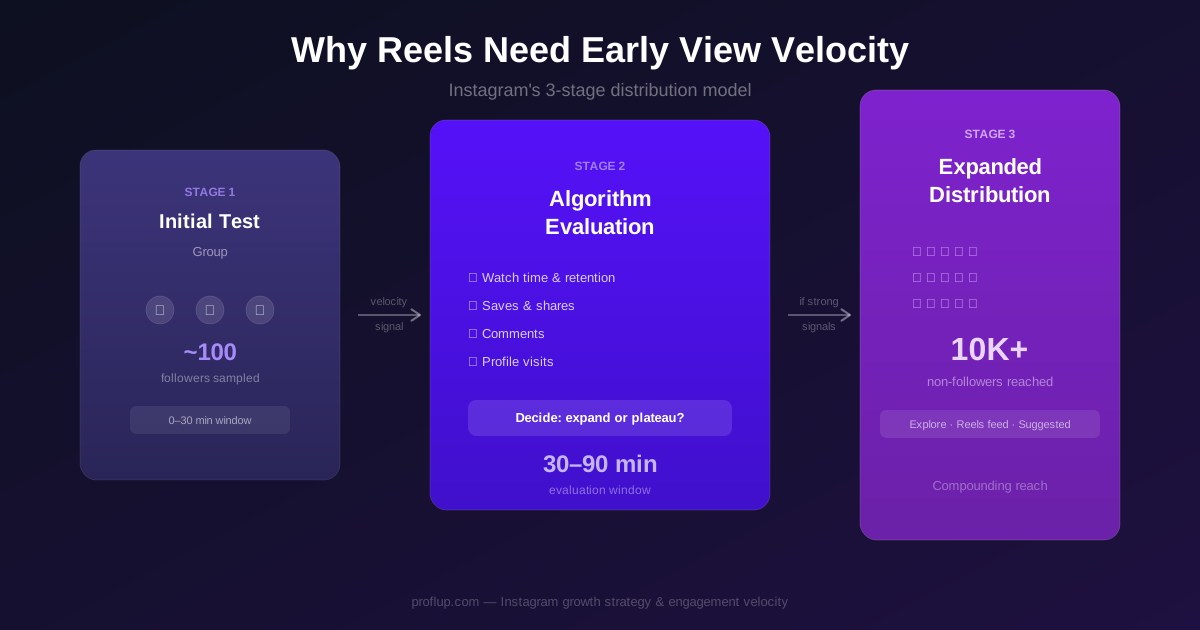

Instagram Reels need early view velocity because the algorithm runs a cold-start test in the first 30–60 minutes after you post. During that window, it shows the Reel to a small sample of followers and non-followers and evaluates watch time, shares, and saves. If those signals are strong, distribution expands. If they’re weak, the Reel plateaus — often permanently. Unlike feed posts, which primarily reach existing followers, Reels are built for non-follower discovery. That’s both the opportunity and the pressure: the test happens fast, and content that starts slowly rarely recovers.
- → Reels go through a cold-start test in the first 30–60 minutes — this window determines whether distribution expands
- → Up to 50% of viewers drop off in the first 3 seconds — your hook decides whether the test succeeds
- → Saves are weighted ~3× higher than likes in 2026 — design for saves, not passive view counts
- → DM shares are now a top ranking signal for Reels — content that gets forwarded gets amplified
- → Trial Reels let you test with non-followers first — use them to validate hooks before full distribution
Why Reels Are Different From Every Other Instagram Format
Feed posts primarily reach existing followers. Stories disappear in 24 hours. Reels are built for non-follower reach — they live in the dedicated Reels tab, the Explore page, and the main feed as suggested content. A well-optimized Reel can continue gaining traction weeks after posting, compounding in ways no other format allows.
But this opportunity comes with a specific pressure. Because Reels are shown to people who’ve never heard of you, Instagram needs a rapid quality signal before it commits to distribution. It can’t rely on your follower relationship or posting history. It uses early performance data — specifically what happens in the first 30–60 minutes — to make that judgment.
That’s the dynamic that makes early view velocity matter specifically for Reels more than for any other content format on the platform.
How Instagram Tests New Reels: The Cold-Start Window
When you publish a Reel, Instagram doesn’t push it to everyone at once. Distribution happens in three stages, each gated by the performance of the previous one:
Instagram shows the Reel to a small group — some followers, some non-followers with matching interest signals. This is the cold-start window where early view velocity is measured.
Did people watch past 3 seconds? Did anyone share it via DM? Any saves? Strong signals relative to other Reels being tested simultaneously push the content to stage 3.
Reels tab, Explore, suggested content in feed. Non-follower audiences at scale. Each expansion stage uses data from the previous one — compounding reach for content that keeps performing.
If you post when your audience is offline, the initial signals are weaker simply because fewer people see the Reel during the evaluation window. CreatorFlow’s 2026 algorithm analysis identifies the first 30–60 minutes as the period that specifically determines whether a Reel gets recommended to non-followers.
The Brutal Reality of the First 3 Seconds
Here’s the most important number in Reels: up to 50% of viewers drop off in the first three seconds. Half your potential audience is gone before they’ve heard what you have to say.
Data across multiple 2025–2026 studies shows that Reels with a 3-second hold rate above 60% significantly outperform those below 40%. The algorithm interprets early drop-off as a signal that the content isn’t worth promoting. If the opening hook doesn’t work, the cold-start test fails before it’s even registered meaningful velocity.
SocialPilot’s 2026 Reels guide makes the implication concrete: Instagram shows Reels to random non-followers first precisely to get unbiased signal data. Those non-followers don’t know you. They only respond to the content itself. Which means your hook has to do the entire job of earning their first few seconds of attention.
The Signals That Determine Whether Distribution Expands
View velocity gets the Reel into evaluation. What keeps it moving is a different set of signals entirely.
The save weighting is worth noting specifically: saves are weighted roughly 3× higher than likes in Instagram’s 2026 ranking model. A Reel that earns saves is telling the algorithm something fundamentally different than one that collects passive likes. Design your content toward saves — tutorials, reference content, templates, anything people will want to return to.
This is why ProflUp’s Engagement Velocity Framework treats saves and DM shares as the primary optimization targets — not view counts. Velocity opens the door to evaluation; saves and shares determine whether the algorithm walks through it.
Trial Reels: Instagram’s Own Tool for Testing Velocity
Instagram introduced Trial Reels in 2025 precisely because early evaluation matters so much. The feature lets you post a Reel that shows only to non-followers first — gathering cold-audience signal data before it reaches your existing followers.
According to Later’s 2026 algorithm breakdown, if a Trial Reel performs well within 24 hours, you can push it to your full audience. If it underperforms, you can delete it without your existing followers ever seeing it. It’s Instagram acknowledging, in product form, that early performance with cold audiences is the signal that matters most.
The practical implication: use Trial Reels to test hooks before committing to full distribution. A hook that generates strong cold-audience completion rate is a hook that will generate strong algorithm expansion.
Why Some Reels Plateau — and What Actually Causes It
Most Reels don’t fail because the content is bad. They fail because of structural problems that suppress early velocity before the algorithm can evaluate quality.
If the first 3 seconds don’t immediately communicate why the video is worth watching, viewers scroll. Up to 50% are gone before your message starts. The algorithm sees the drop-off and halts distribution.
Publishing when your audience is offline means the initial test group reaches followers who aren’t responsive. Slow early velocity even when the content is strong. Check Instagram Insights for your Most Active Times.
Content that doesn’t match your established niche generates weak early engagement from existing followers. The algorithm struggles to categorize inconsistent accounts and weakens non-follower distribution accordingly.
Instagram specifically identifies competitor logos and watermarks and down-ranks that content. Accounts posting 10+ reposts in 30 days are excluded from recommendations entirely — a 2025–2026 enforcement that’s now automatic.
A slow setup that saves the best moment for the middle or end causes viewers to leave before they reach it. The algorithm sees early drop-off, not late value. If the payoff is good, move it to the first 3 seconds.
Gaps in posting break the engagement habits your audience builds around your content. A creator who disappears for two weeks and returns loses the habitual early engagement that seeds strong velocity on new posts.
How to Build Stronger Early Velocity on Reels
Open with your most compelling moment — a surprising statement, a striking visual, or the conclusion of your argument. Don’t build toward something good; start with it. The first 3 seconds have to do the entire job of earning attention from people who don’t know you.
Instagram Insights shows when your followers are most active. Post within those windows consistently. Benchmark data from 2025–2026 studies suggests publishing during peak hours is the single highest-impact change for early velocity.
Ask: would someone forward this to a friend? DM shares are now Instagram’s #1 signal for non-follower reach. Content that gets forwarded gets amplified. The format that earns DMs: useful information, strong opinions, content that makes someone say “you need to see this.”
Saves are weighted ~3× higher than likes. Build content that earns saves: tutorials with steps to revisit, reference information, templates, lists. If nobody is saving your Reels, your distribution ceiling is lower than your view count suggests.
Before full distribution, test your hook with Trial Reels. If it generates strong cold-audience completion rate, push it broadly. If not, iterate the opening before committing. Instagram built this tool for exactly this purpose.
The algorithm monitors early engagement depth — including comment replies. If you don’t respond in the first hour, you’re missing an engagement signal during the window that matters most. Set a reminder if needed.
Why Engagement Pacing Matters More Than Raw View Counts
A Reel with 20,000 views from passive, low-retention watching can perform worse algorithmically than one with 5,000 views where viewers consistently saved and shared the content.
The algorithm isn’t counting views. It’s evaluating what those viewers did. Instagram’s 2026 Reels algorithm is built to surface content that earns meaningful interaction — not content that generates passive scrolling. A high view count paired with a 0.1% save rate is a signal of weak content, regardless of how the numbers look in a screenshot.
This connects directly to how ProflUp approaches early visibility. ProflUp’s automatic likes are delivered from real people through genuine promotion — not bot accounts generating hollow metrics. When real people engage with your content, they may also save it, share it, or visit your profile. That’s the difference between engagement that moves the algorithm and engagement that doesn’t.
For a systematic approach to the early-window optimization process, ProflUp’s Engagement Velocity Framework structures how to approach every post — from timing to delivery to signal tracking. Built specifically for how Instagram’s algorithm works in 2026.
Next: common mistakes that reduce Reel visibility after publishing — including structural errors that are easy to fix once you know what to look for.
Closing Thoughts
Reels are Instagram’s primary discovery engine. The cold-start test that happens in the first hour after you post is when the algorithm decides whether your content earns non-follower reach or stays within your existing audience. Most creators don’t treat that window with the intention it deserves.
The mechanics are clear now. Hook that holds attention past 3 seconds. Publish at peak audience time. Design for DM shares and saves, not passive likes. Reply to comments early. Use Trial Reels to validate before committing.
Velocity is the entry point. Quality signals are what compound it. Both are within your control. And if you want to ensure no Reel starts the evaluation window at zero, ProflUp’s free views trial provides early exposure from real people at no cost — no login, no password.
Frequently Asked Questions
- Why do some Instagram Reels gain views faster than others?
Early view accumulation is shaped by posting time relative to audience activity, hook strength in the first 3 seconds, content relevance to your established niche, and publishing consistency. Reels published during peak audience activity windows, with openings that generate immediate watch time, build early velocity faster — giving the algorithm more data to work with during the cold-start evaluation window. - Does early view velocity affect Reel reach?
Indirectly, yes. Strong early velocity provides the algorithm with performance data sooner, which allows it to begin the expansion process earlier and with more confidence. Strong velocity paired with quality signals — watch time, saves, DM shares — creates the conditions for expanded reach. Velocity alone, without accompanying engagement quality, has limited sustained effect. - What signals matter most for Reels besides view velocity?
In 2026: DM shares are the top signal for non-follower reach, watch time (total seconds plus replay rate) is confirmed as #2 by Mosseri, saves are weighted approximately 3× higher than likes, and completion rate is the primary quality indicator for whether a Reel advances through the distribution stages. Likes still count, but as secondary social proof rather than a primary distribution driver. - How can creators improve Reel performance naturally?
Open with a hook that holds attention past the 3-second drop-off threshold (above 60% hold rate is strong). Publish during your audience’s peak active hours. Design content that earns DM shares — useful, surprising, or shareable information. Build toward saves with reference-style content. Use Trial Reels to test hook strength before full distribution. Reply to comments within the first hour. - What is the Instagram Reels cold-start test?
When you publish a Reel, Instagram shows it to a small initial group — some followers, some non-followers with matching interest signals — for approximately 30–60 minutes. If that test group generates strong watch time, shares, and engagement relative to other content being tested simultaneously, distribution expands to larger audiences. If signals are weak, the Reel plateaus. Content that misses this window rarely recovers because the algorithm moves on to evaluating newer content. - What are Trial Reels and how do they help?
Trial Reels is a 2025–2026 Instagram feature that lets you post a Reel shown only to non-followers first. If it performs well within 24 hours, you can share it to your full audience. If it underperforms, you can delete it without your existing audience seeing it. It’s designed to let creators test hook strength and content quality with cold audiences before committing to full distribution.
Written by the content team at ProflUp — an Instagram growth platform specializing in engagement infrastructure, Reels performance, and creator visibility strategy. ProflUp has been operating in the Instagram engagement space since the AutolikesIG.com era — over a decade of real-world data on what actually moves the algorithm.
🚀 Ready to Grow With ProflUp?
Pick the service that suits your goals and watch your Instagram growth take off.