

Instagram changed again in 2026 – and many creators are feeling fatigue and frustration. After a year of new ranking signals and fresh AI updates, audiences everywhere have noticed that “likes” and follower counts no longer guarantee reach. Instead, the platform now focuses heavily on user intent, retention, and content quality. Creators report seeing arbitrary reach drops on static posts and carousels, and sense that Instagram’s AI is favoring “content that keeps you scrolling.” In practice, that means the algorithm is zeroing in on signals like predictive intent (showing people what they likely want to see next), private DM shares, and longer watch times.
Original, creator-made posts are rewarded over reposts and low-effort content. In short, Instagram 2026 demands a full-stack content strategy – not just viral hit-or-miss posting.
Behind the scenes, Meta’s advanced AI now groups creators by theme (e.g. fitness, fashion, marketing) and grades profiles on how well they keep users engaged across formats. Users who browse multiple posts on your profile, rewatch Reels, or interact with your Stories give stronger signals than one-off likes. “The platform wants to push content that feels fresh, original, and made for Instagram, not recycled from elsewhere,” as Instagram’s team put it. At the same time, Instagram measures user behavior more than ever. Early engagement velocity (how fast likes and comments arrive), profile visit depth (do people click through to read your bio or view multiple posts?), and retention (does your video hold attention beyond 3 seconds?) all factor into who sees your content next.
Many creators have felt these shifts firsthand. One marketer on Instagram’s Reddit forum summed it up: “The 2026 algorithm is the worst ever… It’s pushing Reels over everything and killing static posts,” noting that it now “weights comments, saves and shares” over likes and follower count. This guide unpacks the major 2026 changes (and how to adapt) by focusing on retention engineering, semantic relevance, and engagement patterns that the algorithm rewards.
What Changed in the Instagram Algorithm in 2026?
Instagram’s latest algorithm update in 2026 moved far beyond “who has the most likes.” The platform now treats social media like a predictive engine, prioritizing predictive intent and session behavior. In practical terms, the algorithm predicts what content you want to see next and tests it accordingly.
According to industry analysis, Instagram’s Reels algorithm in 2026 “uses advanced AI-driven algorithms that prioritize viewer relationships, engagement signals (comments, shares) and predictive intent over mere follower counts”. In other words, the platform guesses what you intend to consume and serves it first.
Key signals were boosted this year: for example, DM shares (when followers privately send your post to a friend) became a top ranking factor. Sprout Social reports that Instagram now emphasizes “sends per reach,” meaning private shares on DMs are “arguably the strongest signal” of value. In practice, sending a post to someone signals high trust and relevance, and Instagram pushes content with strong DM-share ratios into more Explore feeds. Creators have noticed that even smaller accounts with high share rates can outcompete larger ones in distribution.
Similarly, saves are weighted more heavily than comments or likes. A save indicates the content was valuable enough to revisit later. Instagram now interprets frequent saves as a long-term intent signal. According to marketing analyses, “Save rate still drives Feed distribution – and now also influences Reels distribution”.
Influencer experts note that save-worthy formats (like how-to carousels or list posts) “generate compounding organic reach,” building topic authority in your niche. Perhaps most dramatically, Instagram cracked down on unoriginal or AI-spun content. In 2026 the platform implemented a formal “original content” ranking update.
For example, a Social Media Today report explains that Instagram “will no longer recommend photos and carousel posts from aggregator accounts” and will give priority to genuine creator content. Sprout Social notes this “aggregator penalty”: reposted memes or TikTok videos (especially those with watermarks) are actively demoted, and Instagram often replaces them in the feed with the original creator’s version. Hootsuite’s review agrees: Mosseri and others explicitly advise against watermarked or recycled clips. In short, AI content detection now hunts down obvious reposts and low-effort generics; Instagram pushes creators to produce original, platform-native work.
Creators have also observed that Instagram treats each niche like its own ecosystem. In 2026, the platform groups accounts by interest or theme (fitness, beauty, tech, etc.) and rewards consistency within that cluster. This means that if you pivot topics erratically, you dilute your authority cluster. A practical tip from SEO-minded guides: make your profile clearly niche-specific.
Profiles that consistently cover one theme benefit from Instagram’s interest graph. In fact, the core principles of Instagram’s AI remain the classic “relationship, interest, recency” model – but 2026 ups the ante on interest/relevance and adds new intent-based metrics.
Lastly, retention is now king. Instagram’s AI now pays close attention to watch time and completion for videos (especially Reels). Early tests show that if a Reel holds 70–80%+ of viewers past 3 seconds, it enters a secondary expansion pool. Instagram wants content that maximizes user session length. While likes and shares still matter, posts that keep users binge-watching or scrolling through the profile are rewarded. In short: in 2026 it’s not enough to snag a glance; you must keep users engaged.
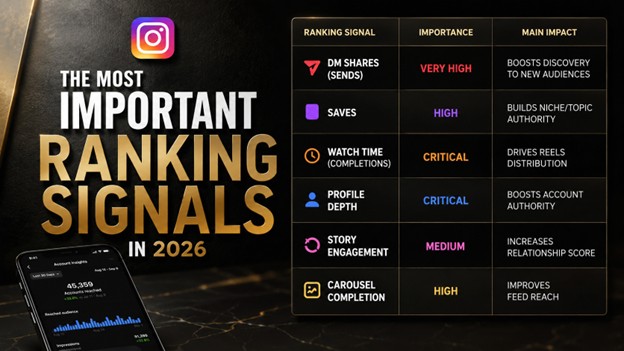
The Most Important Ranking Signals in 2026
By mid-2026, the ranking signal hierarchy is clear. The following are widely cited as the top signals (with illustrative importance):
| Ranking Signal | Importance | Main Impact |
|---|---|---|
| DM Shares (Sends) | Very High | Boosts discovery to new audiences |
| Saves | High | Builds niche/topic authority |
| Watch Time (Completions) | Critical | Drives Reels distribution |
| Profile Depth | Critical | Boosts account authority |
| Story Engagement | Medium | Increases relationship score |
| Carousel Completion | High | Improves feed reach |
DM Shares (Private Sends). By 2026, Instagram explicitly treats a share-to-DM as the strongest engagement signal. When a follower sends your post via DM, it tells the AI “this content hit a nerve.” Consequently, such posts are pushed much wider. Research finds that content with a high share rate often outperforms bigger accounts. (Buffer notes, for instance, that Instagram’s Reels algorithm now heavily weights “share rates” in distribution.) Action point: create shareable hooks or prompts (“tag a friend who needs this!”) to generate those all-important DM sends.
Saves. A save is a public bookmark that screams “I want to revisit this content.” Instagram now views this as a signal of topic authority. Kofluence’s 2026 breakdown notes that save rate “still drives Feed distribution – and now also influences Reels distribution”. That means if followers are continually saving your carousels or posts, Instagram will boost your posts to feeds and Explore more often. Optimize for saves by crafting genuinely helpful or inspirational content (how-to guides, data-heavy infographics) and by encouraging followers to “save for later.”
Watch Time (View Duration). As noted above, retention metrics dominate Reels. The algorithm measures how many people watch your video to the end and how often it’s replayed. In practice, completion rate is king. InVideo’s 2026 Reels guide emphasizes that “completion rate… is the most weighted metric” for recommendations. Reels that keep 70–90% of viewers all the way through (or loop for multiple views) shoot up the distribution ladders. A quick practical framework: front-load a strong hook in the first 2–3 seconds to avoid drop-off (see next section), and aim for pacing that holds attention. The Instagram data team even specifically encourages planning content that boosts average watch time.
Profile Depth/Session. Perhaps the biggest change in 2026 is that Instagram no longer judges posts in isolation: it rewards deep profile sessions. If a user clicks on your profile from a post and then browses multiple posts, Stories, or reels, Instagram logs that extended visit as a powerful signal of authority. For example, industry guides list “profile visits” as a key metric now more important than follower count. Every extra scroll or tap-through sends a signal that your account is engaging. To optimize, use interlinked content strategies: pin high-value posts, prompt “check out Part 2 on my profile,” and create narrative series so each post funnels into the next. The deeper the session, the more Instagram boosts future content.
Story Engagement. Interaction with Stories functions as an ongoing relationship score. Instagram tracks how often a follower watches or interacts with your Stories, and then ranks your next posts accordingly. Mosseri himself has noted that the Stories tray ordering uses “viewing history” and “likelihood to reply” as signals. Put simply, if followers are consistently tapping on and replying to your Stories, your Stories stay at the front of the tray and your feed posts are shown more. Use polls, sliders, and Q&A stickers to generate replies, and aim for frequent story posts: the algorithm favors accounts with active story engagement.
Carousel Completion. Carousels (multi-image posts) in 2026 are surprisingly powerful for feed reach. They naturally boost dwell time because users scroll through multiple slides. According to Hootsuite, when “users are incentivized to scroll through your carousel, they spend more time viewing your post (and this signals a higher ranking to Instagram’s AI)”. In practice, a longer carousel (7+ slides) that audiences finish and save will amplify your feed distribution. Optimize each carousel with a compelling intro slide, step-by-step value slides, and a conclusion/CTA slide (see below for structure). The longer users stay on your post and the more slides they swipe, the stronger the algorithm sees your content.
In summary, by 2026 the old “like count” has become a minor factor. Instead, the speed and quality of engagement matter most: DM shares, saves, watches, profile clicks and story replies dominate the ranking.
Why Reels Still Dominate Discovery
Despite all the changes, Reels remain Instagram’s primary discovery engine in 2026. Now more than ever, short-form video is Instagram’s “express lane” for reaching new audiences. The Reels algorithm is entertainment-first and rewards retention at scale. That means a Reel’s first few seconds and its overall watch performance decide everything:
- Retention Scoring: Instagram assigns a retention score to every Reel. Content that keeps users watching (especially past 3–5 seconds) and rewatching earns bonus distribution. In practice, Reels that sustain 70–80%+ completion rates after the 5-second mark get pushed into broader recommendation pools. Even short loops can help: every replay signals “people love this, show it more.” On the flip side, if a majority of viewers scroll away in the first 2 seconds, Instagram’s AI kills further distribution.
- The “3-Second Hook” Framework: Winning Reels hook viewers immediately. Experts stress that “the battle for attention is won or lost in the first 2-3 seconds”. A dynamic “pattern interrupt” or bold text overlay is key. For example, successful creators often start with a surprising statement (“You won’t believe what changed on Instagram…”) or an eye-catching visual jump-cut. Instagram’s own Mosseri advises reels to “add a strong hook” right away. In practice, 3-second hooks can be curiosity statements (“I made this mistake…”), dramatic visuals (fast zooms or color flashes), or text counters. No slow intros or padding – get to the point instantly.
- Looping & Replay Triggers: Reels that seamlessly loop or build curiosity encourage replays, which the algorithm loves. Think of ending your video on an intriguing note that leads right back to the start (so it loops smoothly), or literally encouraging viewers to watch again. Every replay multiplies your watch time. For instance, ending a Reel with a question or a “watch again to see the secret answer” can boost rewatch rates.
- Suggested Feed Distribution: Instagram’s interest-based engine will continue to pepper your high-retention Reels throughout the main feed and Explore for non-followers. Unlike old feed posts, Reels have their own tab, appear in Explore tiles, and even show up in the home feed as suggestion cards. This “suggested Reels” pathway amplifies content aggressively if initial signals (retention, shares, etc.) are strong. Remember that Instagram also now tracks how many people click the audio page or follow the creator after watching a Reel – those are further signposts of interest.
In short, Reels still rule discovery because they can showcase the new signals Instagram cares about. A high-retention Reel with many shares and saves effectively “earns” placement in front of brand-new audiences. Creators should therefore focus on fast pacing, clear hooks, and content that invites repeat views. For example, a quick before/after demo or a listicle with text overlay can sustain interest. Even trending sounds play a role: using a rising audio can give your Reel extra boost in the first 24 hours. Ultimately, if your Reel holds attention, Instagram rewards you with extra exposure.
Pro Tip: If you are testing a new content format and want to see how the algorithm reacts to initial traction, consider using a free Instagram views service to measure baseline retention without heavily investing upfront.
The Rise of Instagram SEO
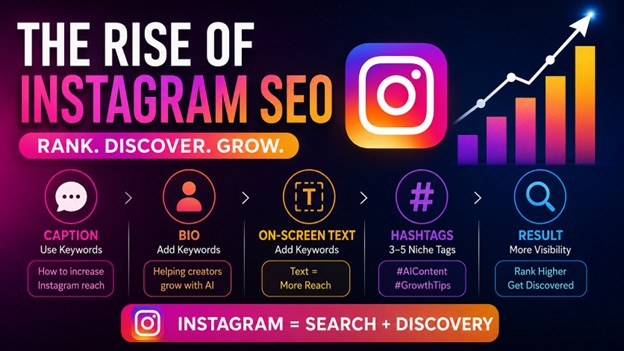
Instagram in 2026 behaves more like a search engine than a pure social feed. Meta’s AI can now parse captions, bios, and even on-screen text, so keywords and context matter more than hashtags. In essence, optimizing your profile and captions for Instagram’s “search” is crucial.
- Captions & Keyword Context: Gone are the days of “just throw a hashtag on it.” Now Instagram semantically indexes your caption text. Buffer notes that “keywords in captions and profiles are now more effective for discovery than hashtags”. For example, instead of a generic caption “New post 🚀🔥”, write a descriptive sentence with relevant terms: “How to increase Instagram reach using retention-based Reels strategies”. This way, when users (or brands) search for “Instagram reach” or similar phrases, your post can appear in the search results or Explore. Think of your caption like SEO copy for Google: be clear, descriptive, and include key terms that match your niche and content.
- Bio Optimization: Your Instagram bio is now a mini SEO pitch. Use clear niche keywords and statements. According to creator tips, a good bio explicitly states who you help and how. For example, contrast “Digital Creator” (weak) with “Helping creators grow faster with AI-driven Instagram systems” (strong). Search-friendly bios improve “profile searches,” making it easier for people interested in your topic to find you. In 2026, Instagram will match search queries to profiles based on bio terms and even action buttons, so fill your bio with relevant keywords (e.g. “fitness tips,” “travel guides,” “marketing strategy”) while still sounding human and specific to your brand.
- Searchable On-Screen Text: Instagram’s AI now scans images and video frames for text and objects. This means any prominent words or titles in your Reels/Stories can boost relevance. Always add readable subtitles and text overlays that include your keywords or main message. For instance, put a headline at the start of your video that contains the topic. Similarly, updating alt text on images (if you use it) helps the algorithm understand the visual content. In short, any text you add (captions, on-screen or even stickers) should align with your keywords and subject.
- Hashtag Usage: Hashtags haven’t died, but they’re secondary classification signals. Use only a few hyper-relevant hashtags (3–5) rather than spray-and-pray. Overusing broad tags looks spammy and as Kofluence notes, the algorithm now treats hashtags as low-importance. Instead, rely more on your crafted caption and keywords. If you do use hashtags, make them niche-specific (e.g. #AIContent #FitnessGrowth) and mix with branded or community tags.
As a result of these changes, Instagram now surfaces content via search and Explore based on context, not just popularity. In fact, some creators say: “Instagram now behaves like a search engine – writing search-aligned captions increases discoverability”. Internal links like our guide on Instagram SEO cover these tactics in depth. Bottom line: think strategically about every word in your bio and captions as if you’re optimizing for Google – because Instagram’s looking at them that way.
Why Carousels Are Crushing Feed Reach
Carousels – once underestimated – are a hidden gem in 2026. They uniquely boost dwell time and session duration, both of which the algorithm rewards. When a follower swipes through multiple slides of your carousel, they stay on your post longer and engage more deeply, signaling quality to Instagram’s AI. There are two main reasons carousels perform so well:
- Increased Dwell Time. Each additional swipe counts as more viewing time. Hootsuite explains that “when users are incentivized to scroll through your carousel, they spend more time viewing your post (and this signals a higher ranking to Instagram’s AI)”. In plain terms, if a post keeps viewers engaged for 10–30 seconds as they flip through slides, the algorithm sees it as valuable. This longer on-post time can even carry into your profile – someone might check your profile after finishing a carousel.
- Higher Save and Completion Rates. Carousels tend to get more saves than single images because they often contain tutorial or list-style content that viewers want to revisit. Completing the carousel (reaching the last slide) also signals strong interest. Instagram rewards posts that “hook” users to go through every slide. In industry benchmarks, carousels with 7+ slides see 40% higher save rates and significantly more shares than one-off images. In practical terms, each extra slide is another chance to deliver value and prompt a save or share.
Creator Example: A fitness coach, for instance, might post a 9-slide carousel on a workout routine. The first slide is a bold promise (“7-move routine to crush abs”), slides 2–6 step through each exercise with images, and slides 7–9 show results or testimonials. Followers swipe all the way, spend half a minute on the post, and often save it. This action tells Instagram that followers find the carousel useful. As a result, the coach’s future posts – especially similar carousels – get a visibility boost.
Carousel Structure Tip: To maximize retention, structure your carousel so each slide delivers a bite of new information. For example:
- Slide 1: Aggressive hook/title that promises value (e.g. “STOP doing X – try this instead”).
- Slides 2–5: Expand the problem or story (show the struggle or common mistake).
- Slides 6–8: Provide step-by-step solutions or tips (each slide is one tip/step).
- Final Slide: Strong call-to-action or question (e.g. “Which tip will you try first?” or “Save this post to review later”).
Encourage swipes by adding arrow stickers or numbering, and explicitly invite them to “read next.” When well-crafted, carousels trigger those extra seconds and save actions that Instagram rewards. Many creators who mix carousels into their feed report consistently higher reach on those posts.
Story Strategy in 2026
Instagram Stories have evolved into a relationship reinforcement engine for your account. In 2026, active story posting and interaction directly feeds into feed and Reels reach by boosting your “relationship score” with followers. Key points for Story strategy:
- Story Tray Priority via Engagement. Instagram ranks your placement in the Stories tray based on how much people watch and interact with your Stories. If a follower consistently views and replies to your Stories, you’ll always appear at the front of their tray. That prime visibility means they’re more likely to engage with your next Story or see your subsequent posts. In practice, you want people looping back to watch every Story. Keeping a short cycle of 5–10 slides per day can be effective.
- Interactive Stickers and Replies. Use poll stickers, sliders, question boxes, and quizzes liberally. Each interactive element encourages a tap or reply, which Instagram registers as a strong signal that “this user likes this creator.” According to algorithm updates, the AI even predicts “how likely you are to tap into a story, reply to a story in DMs or move on to the next story” to determine tray order. So every poll vote or slider interaction pushes you higher. For example, a travel blogger might use a poll (“Which city should I feature next? Paris or Tokyo?”), and each response tells Instagram these viewers care about her content, cementing her profile priority.
- Story Views Still Matter. It might sound obvious, but getting people to open and watch your Stories is itself a signal. Accounts with consistently high Story view counts tend to maintain better overall reach. A story views strategy – posting at times followers are active and cross-promoting Stories in feed – helps reinforce those relationship signals. For example, at ProflUp we advise creating a story views strategy that reminds followers to check in daily (maybe with an engaging series or behind-the-scenes content). The more routinely your audience taps into your Stories, the stronger Instagram rates your profile in their personal ranking.
- Recurring Visibility. Unlike a post that drops off, Stories keep your brand top-of-mind. Posting daily (even brief updates) signals that you’re active and authoritative. A study on creator habits shows accounts that share stories 5–7 times per week see steadier follower engagement. In short, consistency in Stories translates to consistency in how often Instagram feeds your content to users.
By leveraging Stories as a two-way channel, you effectively “train” Instagram to bump you up everywhere. Think of Stories as a loyalty program: each view/vote contributes to your relationship score. A strong story views strategy helps reinforce these signals and keeps your profile consistently visible inside the Story tray.
Engagement Velocity & Algorithm Warm-Up
A critical concept in 2026 is Engagement Velocity – how quickly a post gathers interactions after it’s published. Instagram’s initial “testing phase” for any new content is short, often just the first 30–60 minutes. If a post accumulates high engagement in that window, Instagram infers its quality content and pushes it further.
Industry analysis confirms: “Engagement velocity – the speed at which likes, comments, and shares accumulate – is now a key ranking signal”. Posts that get lots of quick likes and shares are shown to more users. Think of it as Instagram’s “warm-up” test: if enough people react fast, the algorithm gives it the green light. Therefore, generating organic early buzz can dramatically affect reach.
Importantly, tools and tactics that accelerate early engagement have become normalized strategies. For example, many creators now use automatic Instagram likes or similar growth systems strategically during the first few minutes after posting. The idea isn’t to fake going viral, but to ensure the algorithm sees a natural surge.
As one industry report put it, “likes function as a direct engagement signal… posts that accumulate quickly are more likely to be distributed to wider audiences”. In practice, this might mean a mix of notifications to loyal followers (“just posted a new Reel!”), timing posts for peak hours, and subtle boost tactics.
Modern engagement tools focus on behavioral pacing. Unlike crude “buy likes” methods of old, today’s systems randomize timing and target relevant audiences. The goal is to align with natural behavior patterns so the algorithm sees a genuine rush of interest. In other words, the aim isn’t artificial virality but rather helping good content pass its initial test. When done ethically, this gives quality posts the extra momentum they need to reach a meaningful audience instead of stalling early.
ProflUp’s own Instagram growth platform embraces this approach. It uses AI-driven models to simulate authentic interactions in the critical early stage, matching real users’ patterns. This kind of engagement acceleration has become as common as paid ads or influencer collaborations. The key takeaway: strong initial traction is not luck – it’s intentional. By planning for engagement velocity, top creators ensure the algorithm is “warm” to their content before wider distribution begins.
Common Instagram Growth Mistakes
Even with the new rules, some basic pitfalls still cause avoidable drops in reach. Common mistakes to avoid in 2026 include:
- Mixing Random Niches. Posting about unrelated topics confuses Instagram’s interest categorization. The algorithm prefers accounts with a clear theme, so jumping between niches dilutes your authority. As a 2026 guide notes, “your bio and niche clarity influence how Instagram categorizes you”. If you bounce from fashion tips to finance advice with no clear link, the algorithm won’t know which audience to target. Pick a coherent niche and stick to it.
- Weak or No Hooks. A dull first slide or bland caption kills retention instantly. Instagram has made it clear that hooks win or lose in seconds. A common mistake is starting a Reel or carousel with a boring image or generic phrase. Instead, open with a bold promise or surprising fact to stop the scroll. Without that immediate pull, viewers swipe away and your reach suffers.
- Low Retention Content. Short attention spans mean any content that doesn’t demand engagement will be penalized. Posting slow, meandering videos or images with little value yields low watch/completion rates and minimal saves. The algorithm ranks such content lower. To fix this, always ensure every piece of content gives immediate value or intrigue. Use concise editing and clear storytelling so viewers stick around.
- Inconsistent Posting. In 2026, consistency beats occasional virality. Irregular schedules weaken Instagram’s recency signal. For example, accounts posting 5+ Reels weekly have far better reach than those posting once a fortnight. If your content is erratic, the algorithm trusts you less and doles out reduced distribution. Set a sustainable cadence (even 4–7 Reels and daily stories) so the algorithm sees you as reliable.
- Overusing Hashtags. Bombarding posts with dozens of generic hashtags is now a red flag. Meta experts now use hashtags only as minor classifiers, not primary discovery tools. Using too many tags looks spammy and distracts from good keywords in your caption. Instead, pick a handful (3–5) of hyper-relevant tags and focus on strong caption copy.
- Generic AI Content. Finally, simply running content through an AI and posting it without editing is a mistake. Platforms are getting better at spotting low-effort machine-generated text or stock graphics. Instagram rewards “fresh, original” humanized content. If your posts sound robotic or lack personality, they will underperform. Always add your own voice, context, and emotion to AI-generated drafts. The algorithm isn’t against AI per se – it’s against laziness and irrelevance.
By avoiding these common traps, you can ensure the modern algorithm gives your content a fair chance.
FAQ
Does Instagram penalize automation?
Not inherently. Instagram targets invasive bot behavior. Smart automation tools that mimic organic timing and target relevant users generally stay within guidelines. In fact, structured automation for early likes has become an industry norm.
Are hashtags dead?
Not dead, but much less important. Instagram's AI now relies primarily on contextual cues, not hashtags, to categorize content. Use 3–5 niche-specific hashtags max and lean on detailed captions.
Does watch time for Reels matter?
Absolutely. In 2026, total watch time per session is a key metric. The algorithm rewards posts that keep users on the platform longer. Ensuring high watch-through rates is one of the most reliable levers for reach. For accounts struggling to break the "zero-view" algorithm trap, utilizing targeted Instagram views packages can help safely kickstart that essential momentum.
How many Reels should I post weekly?
Most growth analysts recommend 4–7 Reels per week, combined with daily Stories and 1–2 carousels. This frequency keeps your account active without causing burnout.
Can AI-generated captions rank?
Yes – if done carefully. Edit any AI-generated captions to add emotional triggers, relevant keywords, and a human voice. The algorithm rewards the final quality, not how the text was created.
Conclusion
The Instagram of 2026 rewards creators who think systemically. It’s no longer enough to chase viral luck; success comes from building a cohesive content ecosystem. The posts that win now are engineered for retention and relevance, not vanity. They hook viewers instantly, provide substantive value, and encourage further exploration of the profile. In practical terms, Instagram favors:
- Retention-driven content (Reels with strong hooks and pacing, carousels that hold attention)
- An optimized profile (clear niche bio, keyword-rich captions)
- Diverse formats working together (Reels + Carousels + Stories synergy)
- Engagement momentum (strong early engagement signals, including private shares and saves)
- Authenticity and consistency (original creator content, regular posting schedule)
By approaching Instagram as a full-stack content engine, you align with its AI priorities. Instead of randomly posting, plan content that creates “engagement loops”: watch full Reels, swipe through carousels, reply to Stories, and click on profiles. Each loop is a vote of confidence in your content, and the algorithm responds by showing you more favorably.
As one marketer summarized, 2026 Instagram is about profile ecosystems, not one-off posts. The platform now measures the depth of user sessions across your entire profile. Cultivate a strategy where each post leads into the next, every story builds the relationship, and all content contributes to your niche authority. That is how you win today’s algorithm game. Now is the time to be strategic and creative, not passive. Instagram’s evolution means the playing field has changed – but it also means that smart, engaged creators can outpace those relying on old tricks. By focusing on real engagement, retention metrics, and SEO-like tactics, you dramatically improve your chances of lasting organic reach and sustainable growth.
Ready to take this strategy further?
Explore ProflUp’s AI-assisted Instagram growth systems designed for creators, agencies, and brands looking to scale visibility in 2026. Our platform helps you automate smart engagement, optimize content timing, and build the momentum your posts need to thrive under the new algorithm. It’s growth that feels natural, but works in sync with Instagram’s own signals.

References:
Authoritative industry and Meta sources on 2026 Instagram algorithm updates, plus data from benchmark studies and expert guides. These insights have informed the above recommendations for maximizing reach and engagement under the latest Instagram ranking systems.
🚀 Ready to Grow With ProflUp?
Pick the service that suits your goals and watch your Instagram growth take off.