
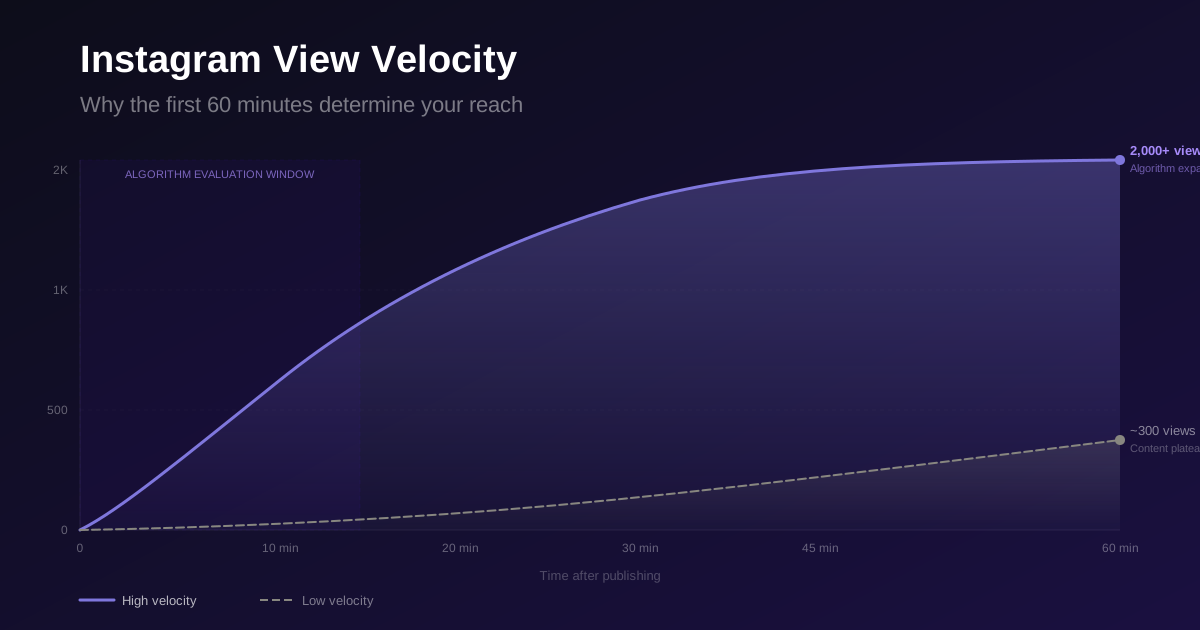
View velocity is the rate at which a post accumulates views in the first 60–90 minutes after publishing. Instagram’s algorithm uses this early speed — not the final total — to decide whether to test content with broader audiences. A Reel that collects 800 views in 45 minutes has fundamentally better distribution prospects than one that reaches 800 views over four days. The early window is when the algorithm evaluates watch time, saves, and shares. Content that starts fast gets evaluated faster. Content that starts slow rarely recovers.
Two posts, similar quality, similar audience — but one takes off within the hour while the other barely moves. It’s not always the content. Sometimes it’s the velocity.
- → View velocity = how fast views accumulate in the first 60–90 minutes — not the final total
- → Instagram confirmed watch time, DM shares, and likes per reach as its top three signals (Adam Mosseri, Jan 2025)
- → Early velocity without quality signals — saves, shares, watch depth — produces limited results
- → Posting timing and hook strength are the two highest-ROI changes within your control
- → Explore prioritizes engagement velocity specifically — more than any other surface
What Is Instagram View Velocity?
View velocity is the speed at which a post accumulates views in the window immediately after publishing. Most commonly measured across the first one to two hours. It’s distinct from total view count — a cumulative number that builds over days.
A Reel that receives 800 views in its first 45 minutes has a very different velocity profile than one that reaches 800 views over four days. The final number looks identical. The algorithmic story is completely different.
Instagram’s recommendation system isn’t evaluating where your content ends up. It’s making judgments about how it performs right after publishing. The speed of those early views is one of the signals feeding into those initial evaluations. Posts that gain traction quickly tend to keep gaining it. Posts that start slowly rarely recover — the testing window closes before they’ve generated enough signal.
Why View Velocity Matters More in 2026
Instagram no longer uses one algorithm. As of 2026, it runs separate AI-driven ranking systems for Feed, Reels, Stories, and Explore — each weighing signals differently. Instagram head Adam Mosseri confirmed in January 2025 that across all surfaces, three signals dominate: watch time, DM shares, and likes per reach.
Of the four surfaces, Explore specifically prioritizes engagement velocity above relationship strength or content type. For creators, this is significant — Explore is where non-follower discovery happens. Getting content surfaced there requires the algorithm to be confident it performs well fast.
Sprout Social’s 2026 algorithm analysis confirms Reels achieve 2.46% engagement on average — but that average conceals enormous variance. Content that triggers the early evaluation mechanism performs multiple times above baseline. Content that misses it stays at the floor.
This connects directly to ProflUp’s Engagement Velocity Framework — a systematic approach to ensuring every post enters that critical early window with the signals needed to trigger broader distribution.
How Instagram’s Algorithm Evaluates Early Performance
View velocity is the entry point. What the algorithm does with it depends entirely on the quality signals attached to those views.
The Buffer 2026 report — which analyzed 52 million posts across 200,000+ accounts — found that saves and DM shares now outperform likes as distribution predictors. Later’s 2026 algorithm breakdown echoes this: shares to friends carry more algorithmic weight than any other action because they signal that the content earned a personal recommendation.
View velocity creates the opportunity for these signals to generate momentum. The quality of those signals determines whether that momentum compounds.
The Relationship Between View Velocity and Reach
When a post performs well in its initial distribution window, the algorithm begins testing it with adjacent audiences — users who follow similar accounts or engage with similar content. If those audiences respond positively, distribution expands again. This is how content crosses from existing followers into genuine discovery.
A ResearchGate study examining Instagram algorithm mechanics through Q3 2025 identifies “immediate engagement velocity” as one of eight core algorithm drivers — alongside watch-through rate, retention, saves/shares, affinity, freshness, network signals, and semantic relevance. Velocity isn’t the whole picture. It’s the door that opens the room.
Content that starts slowly gives the algorithm less data to work with early. The recommendation system doesn’t wait — it moves on to evaluating newer content. This is why posting time and audience activity overlap matter so much. A Reel published when your core audience is most active generates stronger early velocity than the same content published at a low-activity hour.
For creators who want to support this initial signal window while their organic audience builds, ProflUp’s free Instagram views trial provides early exposure at no cost — no login, no password. It won’t replace content quality, but it ensures no post starts the evaluation window at zero.
What Actually Influences View Velocity
Publishing during your audience’s peak activity window gives content its best chance at immediate engagement. Instagram Insights shows when your followers are online. Use that data, not convenience.
The first 3 seconds determine whether a viewer keeps watching or scrolls. Mosseri has confirmed Instagram shows Reels to random non-followers first — if your opening doesn’t hold them, the test ends there.
Reels autoplay and are actively promoted through discovery feeds. Static posts don’t generate velocity the same way. In 2026, longer Reels up to 3 minutes now reach non-followers through recommendations — format choice directly affects which algorithm surfaces your content enters.
Content matched to your established niche generates faster initial responses from existing followers — which seeds stronger early velocity. The algorithm infers audience from engagement history, not just hashtags.
Consistent posting trains your audience to engage habitually with new content. It also signals to the algorithm that an account is active — which influences how aggressively it distributes each new post.
Reposts damage it — accounts posting 10+ reposts in 30 days are excluded from recommendations entirely as of 2025–2026. Original content gets 40–60% more distribution. Recycled clips register as low-velocity content by default.
Three Misconceptions Worth Clearing Up
“More views = better reach.”
The Buffer 52M-post study found that saves and DM shares now predict distribution better than raw view counts. A post with 2,000 views and strong saves outperforms one with 10,000 passive views. Likes “don’t mean much on their own anymore.”
“Strong velocity guarantees virality.”
Velocity gets content into the evaluation window. The algorithm still evaluates continuously after that. Posts that start strong but plateau in engagement quality don’t compound — the expansion stops when the signal quality drops.
“Engagement quality doesn’t matter if velocity is strong.”
Velocity without depth is the most common failure mode for creators who chase spikes. The ResearchGate study identifies this pattern explicitly: velocity opens the door, watch-through and save rates determine how far in the system content travels.
How to Improve View Velocity — What Actually Works
Lead with the payoff, not the setup. Mosseri has confirmed Instagram tests Reels with random non-followers first — those people have no loyalty to you, only to the content. If the first frame doesn’t hook them, the test fails.
Instagram Insights shows your audience’s active windows. Publish into those windows every time. Later’s 2026 algorithm research identifies consistent scheduling as one of the highest-impact habits for sustained reach growth.
Create content people will send to friends or want to return to. A tutorial someone saves. A clip someone sends in a DM. These are the actions that now drive distribution more than passive likes. Build toward them deliberately, not as a side effect.
Your watch time analytics show exactly where viewers drop off. Consistent early drop-off means your opening isn’t doing its job. Adjust the structure, not just the content — often the hook needs to arrive 10 seconds earlier.
For a systematic approach to applying these principles across every post, ProflUp’s Engagement Velocity Framework structures the early-window optimization process — from posting timing to delivery pacing to signal tracking. Built specifically for Instagram’s current algorithm model.
For accounts building velocity from a low baseline, early visibility support ensures no post starts the evaluation window at zero. ProflUp’s free views trial provides initial exposure — no login, no password required. Views from real people who may also engage naturally.
Why This Matters More as AI Recommendations Grow
A growing percentage of Instagram content consumption now happens through recommended content rather than direct follows. Instagram confirmed it reached 3 billion monthly users in 2025, and the platform’s push toward original content has widened the gap between accounts that generate real early signals and those that don’t.
The 2025–2026 update that excluded repost-heavy accounts from recommendations entirely is the clearest signal of where this is heading: the algorithm is becoming more selective, not less. It wants content that earns its distribution through genuine early response — not content that coasts on existing audience size.
For creators focused on organic reach, understanding view velocity isn’t optional knowledge anymore. It’s the frame through which Instagram’s decision-making process actually operates.
Next: how Instagram recommendation systems expand content visibility beyond existing followers — and what positions your content for that kind of organic discovery.
Closing Thoughts
The early window after publishing isn’t downtime — it’s when the algorithm evaluates your content and decides what to do with it. That window is real, it’s short, and most creators don’t treat it with the intention it deserves.
View velocity creates the opportunity. Saves, shares, and watch depth determine what happens with that opportunity. The creators who understand both sides of this — and build consistent habits that support both — are the ones who see compounding reach over time rather than random spikes.
Instagram doesn’t reward spikes. It rewards patterns.
Frequently Asked Questions
- What is Instagram view velocity?
View velocity is the speed at which a post accumulates views in the period immediately after publishing — typically the first 60–90 minutes. It’s distinct from total view count. Instagram’s algorithm uses this early speed to make initial distribution decisions. Content that gains traction quickly enters the evaluation process sooner and with more data behind it. - Does view velocity affect Instagram reach?
Indirectly, yes. Strong early velocity signals to the algorithm that content is worth evaluating for broader distribution. But what actually drives expanded reach is the quality of engagement attached to those views: DM shares, saves, and watch time — confirmed by Adam Mosseri as Instagram’s top three ranking signals. Velocity opens the door; quality signals determine what happens inside. - What are Instagram’s top ranking signals in 2026?
Instagram’s head Adam Mosseri confirmed in January 2025 that the three most important signals across all surfaces are watch time, DM shares (sends per reach), and likes per reach. Saves carry very high weight as a single-action quality indicator. The Explore algorithm specifically prioritizes engagement velocity above other surfaces. - How can creators improve view velocity?
The highest-impact changes are: publishing during peak audience activity windows (check Instagram Insights), opening Reels with the most compelling moment in the first 3 seconds, designing content specifically to earn saves and DM shares, and maintaining a consistent publishing schedule. Reviewing completion rate data after each post and adjusting based on where drop-off occurs compounds these improvements over time. - What’s the difference between view velocity and view count?
View count is a cumulative total. View velocity is the speed of accumulation — specifically how many views a post collects in its first 60–90 minutes. A post can have high view count but low velocity (views trickled in slowly) or high velocity with a moderate total. For algorithmic purposes, velocity is more consequential because Instagram makes distribution decisions in the early window, not after the final tally. - Is view velocity more important than engagement quality?
No. Engagement quality — specifically saves, DM shares, and watch depth — is more important for sustained distribution. Velocity is the early signal that helps content enter evaluation faster. Without quality signals following it, velocity produces a plateau. The ResearchGate study on Instagram algorithm mechanics identifies this combination — velocity plus watch-through plus saves — as the pattern that appears in the majority of high-performing content.
Written by the content team at ProflUp — an Instagram growth platform specializing in engagement infrastructure, visibility tools, and creator growth strategy. ProflUp has been operating in the Instagram engagement space since the AutolikesIG.com era.
🚀 Ready to Grow With ProflUp?
Pick the service that suits your goals and watch your Instagram growth take off.